how to draw a 3d can
Read Time: 15 mins Languages:
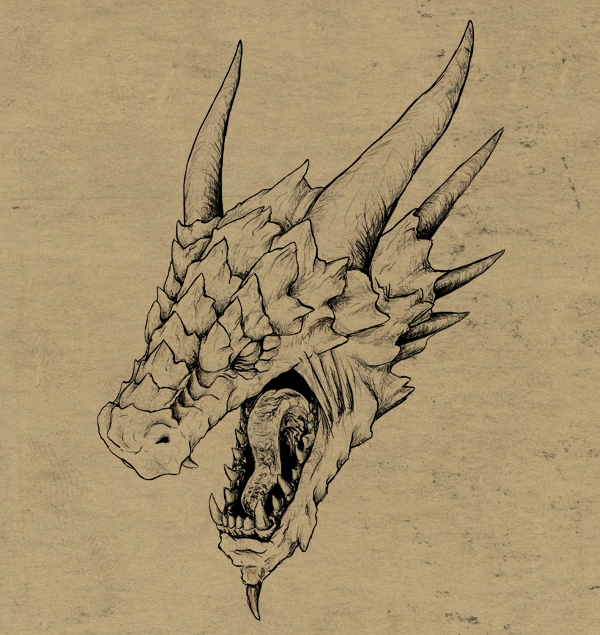

Dragons are beautiful creatures that, unfortunately, don't exist. This elementary fact makes drawing them quite problematic - is at that place whatsoever way to depict them correctly? I can show you how to describe a dragon caput in a realistic style, in every pose in 3D space. You merely need to consider the basic construction of a skull shape and work from there.
i. View the Skull in 3D Shapes
Step ane
Hither's a 3D model of a dragon skull I've created for you lot (y'all tin download information technology and utilize equally your reference in any 3D software). I'grand going to refer to this 3D model to show you the key areas on the skull. Tin you identify the upper jaw, the lower jaw and the brain example? You could even pick out the eyeball socket, the nostrils, teeth and horns. If yous consider each i of these areas, yous can build upon it to design your ain dragon. That'southward all nosotros're going to need.


Step ii
Here's a plan of the same skull. Simplified plans are the best manner to starting time a cartoon. This plan is nevertheless as well complicated, though. There are also many weird angles you'd need to have intendance of when turning the head. Let's simplify it fifty-fifty more!


Step 3
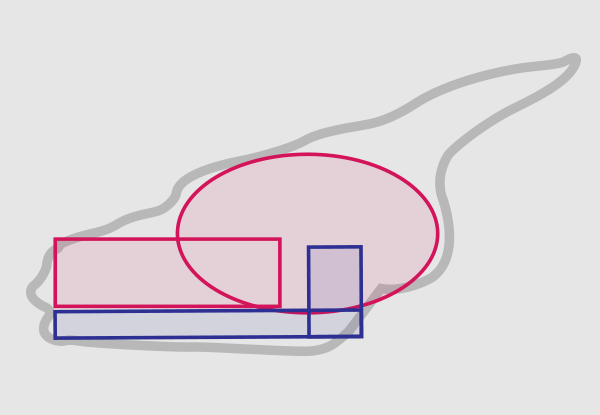
There it is! Equally yous can see, it's less accurate - information technology doesn't fit the skull'southward outline any more than. All the same, uncomplicated shapes make the pose establishment easier, and nosotros tin rework them later to suit our needs.

Step 4
While the upper part's move depends on the neck, the lower jaw tin movement on its own upwardly and down (and sometimes left and right besides, merely pure carnivores can't really chew). The circle point shows the axis of rotation nosotros'll need later. Try looking at other skulls of carnivores for examples of this mechanism, like crocodiles. They have long palates which rotate on a similar axis.


Step five
OK, so we know how to depict a dragon head from ane side. But if yous tried cartoon dragons earlier, y'all probably guessed how to become this far on your own, equally it's quite intuitive. What you lot want to learn is how to create a 3D pose, right? So, let's create 3D blocks of the 2D shapes that the skull is congenital of.
Basically, we've got an oblate ball, a cuboid and an "L" shape laying apartment. These blocks volition permit us build a dragon head!


2. Create a 3D Pose
Earlier nosotros start, let'south become technical. This tutorial will be based on simplified perspective tips. While it'southward not "technically" accurate, it'south a practiced do to practice the thinking in 3D. How you envision a dragon may exist dissimilar to how I do; that is completely fine. However, we're going over the 3D mechanics of a skull for the initial function of the tutorial and this theory work volition be valuable for your ain creations.
Step 1
Permit'due south showtime with a ball. It doesn't demand to be perfectly round, what nosotros practise now is just a sketch, a base for something more.
- If you depict traditionally, keep the sketch light and almost invisible (a difficult pencil may be good for this phase).
- If you draw digitally, keep the sketch on a layer yous'll be able to delete afterward.
The pointer shows the direction our dragon will be facing.


Step 2
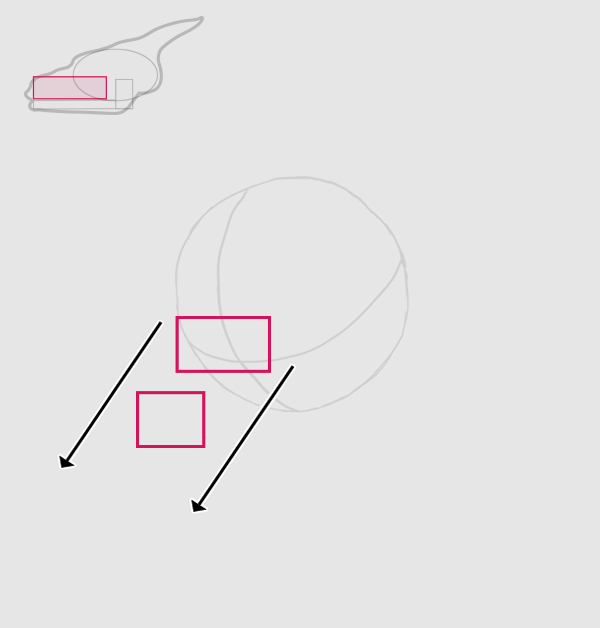
Time for the upper jaw. We need to draw the 3D cuboid. Intuitively, we should draw ii rectangles. Every bit the oral fissure is tapered, you'll need to make the rectangle at the front of the oral fissure smaller.
The vertical altitude should depend on the mouth'south length, while their horizontal altitude should depend on the arrow'south direction. It's but partially correct, though.

Stride iii
The one-signal perspective cube that we draw in geometry classes is, in fact, an impossible figure. This means y'all tin can draw it, simply it doesn't be in 3D infinite. Don't believe me? Simply take any cube and endeavor to place information technology a position to run into a perfect square and a flake of two sides at the same fourth dimension. Surprised?
To brand the rima oris more natural, we demand to tilt one of the sides - a or b. The next step will go into more detail about this.


Step 4
Here comes some math! If yous're familiar with perspective rules, y'all tin skip this pace. The rest of yous, don't worry - you don't need to larn everything past heart, these rules are pretty like shooting fish in a barrel to follow:
- When all the sides are the same lengths and the angles are ninety degrees, we tin can see a foursquare.
- When you rotate the effigy horizontally, the left or right side appears. The more than you rotate, the shorter
candabecome, then more of the new side is visible. - When you rotate the figure vertically, the top or lesser appears. The more than y'all rotate, the shorter
banddbecome, and then more than of new side is visible. - Yous tin't run into both the top and bottom at the same time.
- You can change the angle betwixt sides to meet 3 of them at the same time.


Step 5
Permit's come back to the dragon. Now create the correct 3D shape. You are free to use any lengths and angles for now, merely after yous'll need to match the other elements to them.


Step six
We'll depict the lower jaw now. Do you lot recall the "L" shape? It should be longer than the upper jaw, with an boosted part fastened to it. Information technology likewise needs to exist placed right under the upper jaw.
My mouth is going to be tapered, so the part in the front is smaller then the one backside it. Notice that I attach the bigger function to the back of the upper jaw.


Step 7
Since the lower jaw is longer than the upper jaw, and they both commencement at the same point, nosotros need to move the dorsum part a bit deeper. To find the correct management for it, you can draw two lines across the upper jaw's sides. If your oral fissure is tapered like mine, yous need to pretend information technology'south a cuboid for a moment.


Step viii
At present just "slide" the back part across your guides to get the correct distance.


Step 9
This is the like shooting fish in a barrel office: draw in the residual of the jaw.


The pose is ready! Look... A dragon with its mouth closed is a peaceful dragon, but what if we want to describe a fearsome muzzle seething with anger? See the side by side steps if you want to acquire the answer.


3. Describe an Open Rima oris in 3D Space
Step ane
If nosotros want an open oral fissure, we demand to draw the residuum of the "L" shape. Its dorsum, upper part volition be the centrality of rotation; we need this centrality to define the side by side pose.


Step 2
Permit'southward open the rima oris as much as possible (a correct angle is the limit, in my opinion). A 90 degree rotation is quite easy to do; the top becomes front side and the back becomes top. The right side just switches the lengths.


Pace 3
We need to detect the middle of the mouth. To practise this, draw a line beyond the upper jaw and the rotated block. Then draw a vertical line down. The bending betwixt the two lines is 90 degrees, merely perspective alters it.


Stride 4
Imagine a huge circumvolve with a heart in the corner of our right angle. Depict only the role that's between the lines.


Step 5
An open up mouth will be moving along a curve. You lot can meet the front role of the lower jaw will keep narrowing while sliding downwards, until we stop seeing its front (and the within is visible instead).


Step half-dozen
To have the mouth wide open, you need to draw the front of the mouth turned away from yous, then connect it as usually with the rotated dorsum part. The lower lip should affect the bend.


Pace 7
Since you know how the closed and fully open mouth looks, you can easily discover every transitional position. Y'all just need to imagine the "Fifty" part rotating over the axis, and the mouth sliding over the bend betwixt jaws. Retrieve to e'er touch it with the lower lip!


Step eight
This is how my dragon guide sketch looks. If yous're drawing traditionally and your sketch looks very messy now considering of all these lines we don't need any more than, you can trace the sketch on a new page. Go along it low-cal! If you're drawing digitally, just lower its opacity, lock it, and create a new layer.


4. Form the Basic Construction of the Dragon
Step 1
In one case we have our elementary blocks defined, we need to add more complicated blocks to pad out the face up. When you lot draw a dragon without thinking about 3D, y'all just draw an center or eyes, nostrils and horns, and that's all. The whole confront is apartment and unnatural. You need to plan the face up masses first, and then draw all the bulges and depressions. See them in 3D!
Again, it'south still in the sketch phase. It means you need to keep the new lines light (or on a new layer). Let's draw the upper jaw first. It should be connected to the ball, but yous don't really need to be strict with the shape. Use the pose sketch as a guide, merely don't trace it.


Stride 2
Describe a brow too. Every bit you can see, I didn't worry about the model's size at all. It'due south the direction that matters.


Step iii
Add the brow ridges at a whole brow's width. You tin even draw them from the nose to the end of the head.


Step four
The lower jaw is almost traced, as at that place's no room for any changes (yet).


Footstep 5
Place the center in a socket. Where to place it? 1 helpful tip: herbivores generally accept their eyes on both sides of the head for the widest field of vision possible (to see an enemy while eating). Carnivores have their eyes on the front of the face up for a precise sight (compare a horse and a lion). Therefore:
- If you want a dragon with gentle expect, identify its eyes relatively far from the forepart of the face.
- If you want a murderous animate being, place its eyes closer to the oral fissure.
Can you guess what kind of dragon I drew?


Step 6
Since all the shapes are nicely defined, nosotros tin start drawing for existent! Catch a softer pencil or create a new layer and let's go!


5. Draw the Dragon'south Features
Step ane
While horns await pretty easy to draw, people tend to have problems with them. Everyone has their ain style, only if you want your dragon to look natural (so, more realistic), don't brand them abrupt. Horns wear down when used! As well, straight ones look quite artificial, and then curve them a trivial.


Step 2
Dragons are generally covered with small scales that resemble skin (like snakes), or with large plate-scales. While small scales are very easy (and boring) to draw, plates are what make them look massive and armored. Once y'all acquire how to draw them, you'll see it's much faster than roofing whole trunk with a bazillion lilliputian ellipses! Then, three tips:
- You can imagine a single plate-scale is a hand with three fingers. This manus tries to encompass the surface it'due south laying on, so near of the time we'll run into simply a one-half of it (two fingers).
- When the scales grow bigger, they don't merely increase their size - they're similar fractals. It works like a growing tree that gets more branches with a time.
- Scales lay upon each other, only they're not glued together; when their base is bending, they "open".


Step 3
When y'all describe a calibration (or anything made of natural fabric), it doesn't need to be perfect. Nature isn't perfect! Scales aren't made of plastic; they have been growing for a long time, in the rain and cold; they take been hit and scratched, and that has changed them. (Or, if your dragon is made of adamantium, nil changed them. Perfection is fine in that example.) Don't exist agape to heighten your pencil and come dorsum to the line you just started - long, smooth lines requite a cartoony look. Don't endeavour to fix your lines either, or you lot'll get a mess.


Step 4
Since we know how the scales work, we tin can outset to dress our dragon. First, we'll take care of the eyebrows. They wait just similar tapered cylinders, and so it'due south easy to imagine how the scales should be placed. Start with the one on the front - the simply ane that will be fully visible. And so describe another, a little bigger, and so on. Every other scale may be more than complicated than the previous i, just equally if yous were cartoon them growing!


Step v
At present, place your scales from the nose to the end of the head. This time they're quite like, as the surface they're laying on barely changes its shape. They besides can lay flat.


Pace six
I'thousand not going to teach you virtually an eye'south shape, because they can exist actually unlike. However, at that place's 1 universal thing: the center is placed in the eye socket, covered with eyelids, and protected with 2 big bone masses - the forehead ridge and the zygomatic bone. At that place are ii things to call back:
- If dragon's peel is very thick, the eyelids are probably quite thick too - therefore, when the heart is open, the eyelid volition have a stiff wrinkle.
- In that location'southward a right bending betwixt the superlative of the zygomatic os and the eyeball, so proceed that in mind when irresolute the pose.


Step seven
This is how I drew the center:


Pace 8
Fourth dimension to draw the rest of the oral cavity. Draw it with your hand shaking - this way you'll become a lot of interesting shapes, which are then much better than boring smooth lines. Likewise, can you come across the niggling low? Information technology's not required; you tin can keep your mouth round if you want.


Step ix
Allow's draw the lower jaw! Information technology'southward going to exist quite complicated, because of all the teeth and so on, so let'south take it tedious. Offset, draw the front office of the jaw (a shaking paw will help you again). Nosotros besides need to add this strong jaw musculus that opens the rima oris. The bigger the angle of opening, the more than stretched the muscles. This tension adds a lot to the moving-picture show!


Step 10
Generally, teeth are going to use the same curve to slide over when the mouth is opening, because the upper and lower ones want to meet - just like the jaws. Also, don't forget:
- Teeth clothing out too! Don't make them all pointy or they'll seem unused.
- The kind of teeth tells a lot about your dragon. Should they be like a T-Rex's, or more like a lion'southward? What does information technology swallow, and how does information technology hunt?
- Dragons can't expose their gums like wolves, considering their skin is much harder, but they still should be visible when the mouth is open.


Step eleven
A tongue is usually plump, so don't make it flat. It needs to help the huge animal swallow quite large things, later all! Points to consider:
- If your dragon can eject its natural language long out of the mouth while roaring, ask yourself: what's the point of this? I don't really know any animal that does it, so you need to find a good reason to make information technology "realistic".
- A forked tongue is an organ of aroma. Snakes flick their tongues out all the time and, theoretically, your dragon should practise the same if it has a forked tongue. Otherwise, it'due south pointless!


Step 12
The head is most complete, so let's simply add together an element to merge both jaws together. You tin apply bony wings hither, boosted horns and spikes, annihilation yous like! Only remember - information technology all should serve a purpose (for example, to look bigger or more attractive for a potential mate).


Step 13
So, the head is washed! It's still simply a line fine art, so if y'all want to learn how to make it more bonny, see the next stride.


6. Add a Spark to Your Cartoon
Stride 1
Nosotros're going to do the inking now. Digital artists are in a better position here, but traditional markers and ball pens will exercise too!
Our picture is made of lines of almost the same width. Stress some of them to add importance to the various areas.


Stride two
Add some darkness to wherever it's needed. Here, I want to show the difference between the inside and the outside of the mouth.


Step 3
Embrace the horns and teeth with thin curves. They should be thinner than nigh of the lines that build the picture.


Step 4
Use the same thin lines to sketch shaded areas. Continue it loose and fast. When you want to darken a place, cross the lines, but don't change the pencil!


Step 5
Hither is what I've got by calculation depth to the scales.


Step 6
Look at your picture and check whether information technology needs whatsoever more contrast. If a place is already covered with lines and you lot want to make it darker, yous can use a bigger brush or softer pencil there.


Awesome Piece of work, You're Now Done!
You've only learnt how to create a 3D pose and draw a disarming dragon caput. I hope you liked it! Feel free to come up back here any time if you need a quick reminder.

Source: https://design.tutsplus.com/articles/how-to-draw-a-realistic-dragon-head-in-3d-space--vector-14639

Post a Comment for "how to draw a 3d can"