Considering the Purpose for Writing Is Important When Reading a Nonfiction Work.

WHAT IS THE Author'S PURPOSE?

When nosotros talk of the writer'due south purpose we are referring to the why behind their writing. What motivated the writer to produce their work? What is their intent and what exercise they hope to achieve?
The author's purpose is the reason they decided to write well-nigh something in the start place.
There are many reasons a writer puts pen to paper. It's important that our students possess the necessary tools for identifying these various reasons and intents.
Being able to place the writer's purpose accurately is admittedly essential if the student is to effectively evaluate a piece of writing.
WHAT ARE THE Different TYPES OF AUTHOR'South PURPOSE?
Depending on who you talk to when the question is raised about how many types of author'southward purpose there are, you'll mostly be quoted a number ranging from around three to about 7.
A good starting betoken for students starting time to learn more than about the unlike types of authors' purpose is, to begin with, the main three: to persuade, to inform, and to entertain. These can easily be remembered with the PIE acronym.
Notwithstanding, these 3 correspond only an introduction. In the interests of covering the topic a little more comprehensively, we will ascertain 5 different types of author's purpose, look at some examples of each in employ, and give a few pointers helpful in identifying them.
AUTHOR'South PURPOSE DEFINITION
The author'southward purpose is their intent (or purpose) for writing something. To either persuade, inform or entertain an audience.
You will virtually usually see these three aspects attributed as being the author'southward purpose however other elements such every bit describing and explaining are commonly sighted as well.
We will explore the author's purpose in much more detail throughout this commodity.
A Consummate UNIT ON THE Writer'S PURPOSE FOR STUDENTS
An entire unit on THE AUTHOR'South PURPOSE awaits you. Absolutely no prep required. This editable PowerPoint bundle provides you with a proven resources based on research skills, writing strategies and engaging content. The bundle includes65 PAGES OF:
THE Dissimilar TYPES OF AUTHOR'S PURPOSE
THE Author'S PURPOSE i: PERSUADE

Definition: This is a very mutual purpose of writing, particularly in nonfiction writing. When a text is written to persuade information technology will aim to convince the reader of the merits of a certain signal of view. With this type of writing the author volition attempt to persuade the reader to agree with this signal of view and/or subsequently have a particular course of action.
Examples: This purpose can be found in all kinds of writing. It can even exist in fiction writing when the author has an agenda, whether consciously or unconsciously. However, it is nigh ordinarily the motivation behind essays, advertisements, and political writing such equally speeches and propaganda.
How to Identify: To identify when the author's purpose is to persuade, students should ask themselves if they feel the writer is trying to get them to believe something or have a specific action. They should learn to place the diverse tactics and strategies used in persuasive writing such as repetition, various types of supporting evidence, hyperbole, attacking opposing viewpoints, forceful phrases, emotive imagery and photographs etc.
We take a complete guide to persuasive writing hither if y'all would like to learn more than.
THE Author'S PURPOSE 2: INFORM

Definition: When an author's purpose is to inform, they usually wish to enlighten their readership about a real-world topic. Often, they will do this by providing lots of facts. Informational texts are geared toward imparting information to the reader with the purpose of educating them on a given topic.
Examples: Many types of school books are written with the express purpose of informing the reader. Added to textbooks, we also accept encyclopedias, recipe books, and newspapers.
How to Identify: In the process of informing the reader, the author will brand utilise of facts and this is ane surefire way to spot the intent to inform.
However, when the author's purpose is persuasion they will besides exist probable to provide the reader with some facts in an attempt to convince the reader of the merits of their particular case. The main difference between the two different means facts are employed is that, when the intention is to inform, facts are presented but to teach the reader. When the author'south purpose is to persuade, they volition commonly mask their opinions amongst the facts.
Students must become proficient at recognizing 'hidden' opinions through exercise. Teach your students to beware of persuasion masquerading as information!
IF you would similar to learn more than about writing an information report be sure to read our consummate guide hither.
THE AUTHOR'South PURPOSE 3: ENTERTAIN

Definition: When an author'south master purpose is to entertain the reader they volition endeavour to proceed things as interesting as possible. Things happen in books that are written to entertain, whether in the form of an activeness-packed plot, inventive characterizations, or sharp dialogue.
Examples: Not surprisingly, a corking deal of fiction is written with the aim of entertaining, especially genre fiction. For example, nosotros discover entertaining examples in scientific discipline fiction, romance, and fantasy – to name only a few.
How to Identify: When a writer is attempting to entertain or amuse the reader they will utilize a variety of techniques to engage their attention. They may employ cliffhangers at the terminate of a affiliate, for instance. They may weave sense of humor into their story, or even have characters tell jokes. In the case of a thriller, an action-packed scene may follow an action-packed scene as the drama builds to a crescendo. Remember of the melodrama of a lather opera here, rather than the subtle affect of an fine art business firm masterpiece.
THE AUTHOR'S PURPOSE 4: EXPLAIN
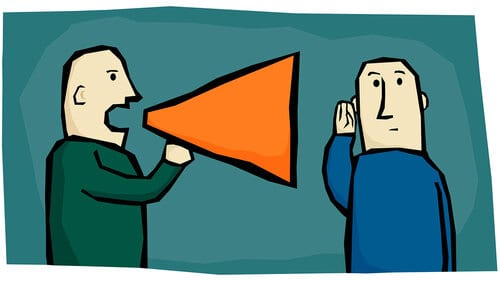
Definition: When writers write to explicate, they want to tell the reader how to do something or reveal to them how something works. This type of writing is about communicating a method or a procedure.
Examples: Writing with the purpose of explaining can be found in instructions, footstep-by-step guides, procedural outlines, and recipes.
How to Identify: Often you will find this blazon of writing organized into bulleted or numbered points. As it focuses on telling the reader how to practice something, often lots of imperatives will be used within the writing. Diagrams and illustrations are often used to reinforce the text explanations too.
Read our complete guide to explanatory texts hither.
THE Writer'South PURPOSE 5: DESCRIBE

Definition: Often writers will use words to describe something in more than detail than be conveyed in a photograph alone. After all, they say 'a motion picture paints a m words and text can help get us beyond the ane-dimensional appearance of things.
Examples: We can find lots of descriptive writing in obvious places like short stories, novels and other forms of fiction where the author wishes to paint a picture in the reader'south imagination. We can also find lots of writing with the purpose of description in nonfiction too – in product descriptions or descriptive essays, for example.
How to Identify: In the case of fiction writing which describes, the reader will notice the writer using lots of sensory details in the text. Our senses are how nosotros perceive the earth and, to describe their imaginary globe, writers will depict heavily on linguistic communication that appeals to these senses. In both fiction and nonfiction, readers will observe the author will rely heavily on adjectives in their writing.
Costless AUTHOR'S PURPOSE Anchor CHARTS & POSTERS
THE Author'Southward PURPOSE Teaching ACTIVITIES
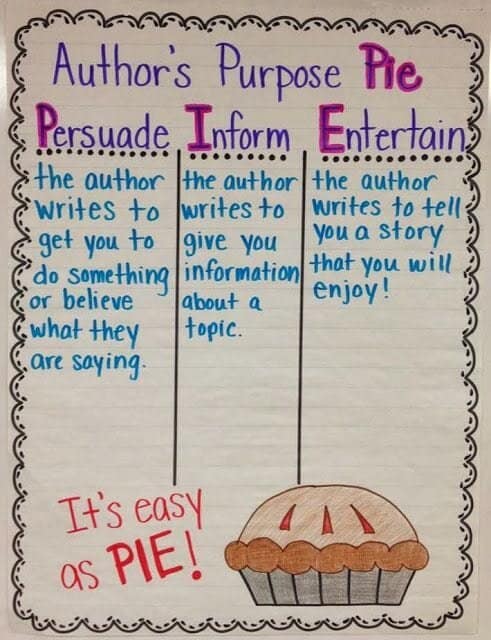
The Author's Purpose Job 1. The Writer's Purpose Anchor Nautical chart
Whether introducing the general idea of the writer'southward purpose or working on identifying the specifics of a single purpose, an anchor chart tin can be a great resources for students when working independently. Compiling the ballast chart collaboratively with the students can be an effective way for them to reconstruct and reinforce their learning.
The Author's Purpose Chore two. Gather Real Life Examples
Challenging students to identify and collect together real-life examples of the diverse types of writing as homework can exist a cracking fashion for them to get some hands-on practice. Encourage your students to assemble diverse forms of text together indiscriminately. They so sift through them to categorize them appropriately according to their purpose. The students will shortly begin to see that all writing has a purpose. You may also like to make a classroom brandish of the gathered texts to serve every bit examples.
The Author's Purpose Task 3. DIY
One of the well-nigh effective means for students to recognize the authorial intent backside a piece of writing is to gain some feel in producing writing for various purposes themselves. Design writing tasks with this in heed. For example, if you are focused on writing to persuade, yous could challenge the students to produce a script for a radio advertisement. If the focus is to entertain, yous could ask the students to write a funny story etc.
The Author's Purpose Task 4. Classroom Discussion
Organize the students into small discussion groups of, say, iv to 5. Provide each group with copies of sample texts written for various purposes. Students should take some time to read through the texts by themselves. They then work to identify the writer's purpose, making notes equally they go. Students can hash out their findings equally a grouping.
Think: the various purposes are not mutually exclusive, sometimes a text volition have more than than a single purpose. It is possible to exist both entertaining and informative, for example. It is important students recognize this fact. Careful selection of texts can ensure the students become an opportunity to discover this for themselves.
In Summary
Students need to understand that regardless of the text they are engaged with, every piece of writing has some purpose behind information technology. It's important that they work towards recognizing the various features of different types of writing that reveal to the reader simply what that purpose is.
Initially, the process of learning to identify the different types of writing and their purposes will require witting focus on the part of the student. There should exist plenty of opportunities created to permit for this necessary practice in the classroom.
This practice doesn't accept to be exclusively in the form of discrete lessons on the author's purpose, however. Simply asking students what they recall the author'due south purpose is when reading whatever text in whatsoever context, can be a nifty way to become the 'reps' in quickly and frequently.
Eventually, students will brainstorm to recognize the author'southward purpose quickly and unconsciously in the writing of others.
Ultimately, this improved comprehension of writing, in full general, will benefit students in their own independent writing.

THE Writer'Southward PURPOSE DEFINITION AND TUTORIAL VIDEO
This video is an fantabulous introductory guide to nowadays to students looking for a unproblematic visual breakup of what the author's purpose is, and how it can impact their arroyo to writing and assessment
OTHER Nifty Manufactures RELATED TO THE Author'S PURPOSE
Teaching Crusade and Effect in Reading and Writing
What is Cause and Effect? Developing an understanding of how crusade and outcome inform the arrangement of a text enhances a educatee's ability to fully comprehend what they take read. But, what exactly practice we mean when we speak of cause and outcome in relation to reading? Cause is the driving force in the text….
The Writing Procedure
The Writing Process Explained Understanding the writing process provides a student with a clear step-by-step procedure that they tin follow. It means they tin replicate the process no matter what type of nonfiction text they are existence asked to produce. In this article, nosotros'll take a look at a simple and powerful v-part structure that…
Elements of Literature
WHAT DO WE Mean By THE PHRASE 'ELEMENTS OF LITERATURE? The phrase 'elements of literature' refers to the elective parts of a work of literature in whatever form it takes: verse, prose, or drama. Why are they important? It's of import students understand these common elements if they are to competently read or write a…
Didactics The 5 Story Elements: A Complete Guide for Teachers & Students
What Are Story Elements? Developing a solid understanding of the elements of a story is essential for our students to follow and fully comprehend the stories they read. Notwithstanding, before students can empathize how these elements contribute to the overall meaning and upshot of a story, they must first be able to place the component…
OUR PURPOSE
The purpose of literacyideas.com is to provide teachers and students with a collection of guides, resources, and tools to better literacy levels for all ages and ability levels. Why? Because literacy is primal to a person's ability to larn at school and to appoint productively in society.
Since launching in 2022 we have had millions of teachers and students from around the world access our always-growing text-type writing guides, reading skills, and general writing skills tutorials.
Nosotros are constantly revising and add together content to run across your needs every bit literacyideas.com continues to grow and evolve into 1 of the near popular sites for teachers and students to improve reading and writing skills.
Thank you for visiting, please share information technology with others, and be sure to check dorsum regularly.
Content for this page has been written by Shane Mac Donnchaidh. A former principal of an international school and academy English lecturer with 15 years of teaching and administration feel. Shane's latest Volume the Complete Guide to Nonfiction Writing can exist establish here. Editing and support for this article have been provided by the literacyideas team.
Source: https://literacyideas.com/authors-purpose/

Post a Comment for "Considering the Purpose for Writing Is Important When Reading a Nonfiction Work."